

Driving in Iceland
Road conditions, rules, tolls and road signs for driving a campervan in Iceland.
Travel Conditions
The weather in Iceland can be unpredictable and change quickly, so it’s important to check the weather forecast and road conditions regularly, especially when traveling the highlands during summer or the ring road during winter. The map below shows today’s road conditions and which roads your camper may drive.


Our 2×4 campers are NOT allowed to drive on roads marked RED or GRAY, or with a dotted GREEN line (highland roads, even when they are open), on the live Road Condition map.
Additionally, all F-roads are off limits to our 2x4 campers as well as the following roads:
Forbidden Road Driving Subject to Fine
Driving on forbidden roads or off road (paths, tracks, beaches or any other place that does not have a road name or a number) costs a fine of €10 per driven km, measured by the tracker in the camper.
NO insurance covers damages that occur on forbidden roads or off road.
Our 4×4 campers are NOT allowed to drive on roads marked with RED or GRAY on the live Road Condition map.
Additionally, the following roads are off-limits to our 4x4 campers:
Forbidden Road Driving Subject to Fine
Driving on forbidden roads or off road (paths, tracks, beaches or any other place that does not have a road name or a number) costs a fine of €10 per driven km, measured by the tracker in the camper.
NO insurance covers damages that occur on forbidden roads or off road.
Useful Info and Links
Obtaining information regarding road conditions, weather forecast and general warnings while traveling in Iceland is on the renter’s responsibility. Here below you can find all the necessary resources to stay up to date on travel conditions.
Get Alerts From SafeTravel.is
Stay informed and get alerts sent to your phone live from safetravel.is
On-Road Assistance
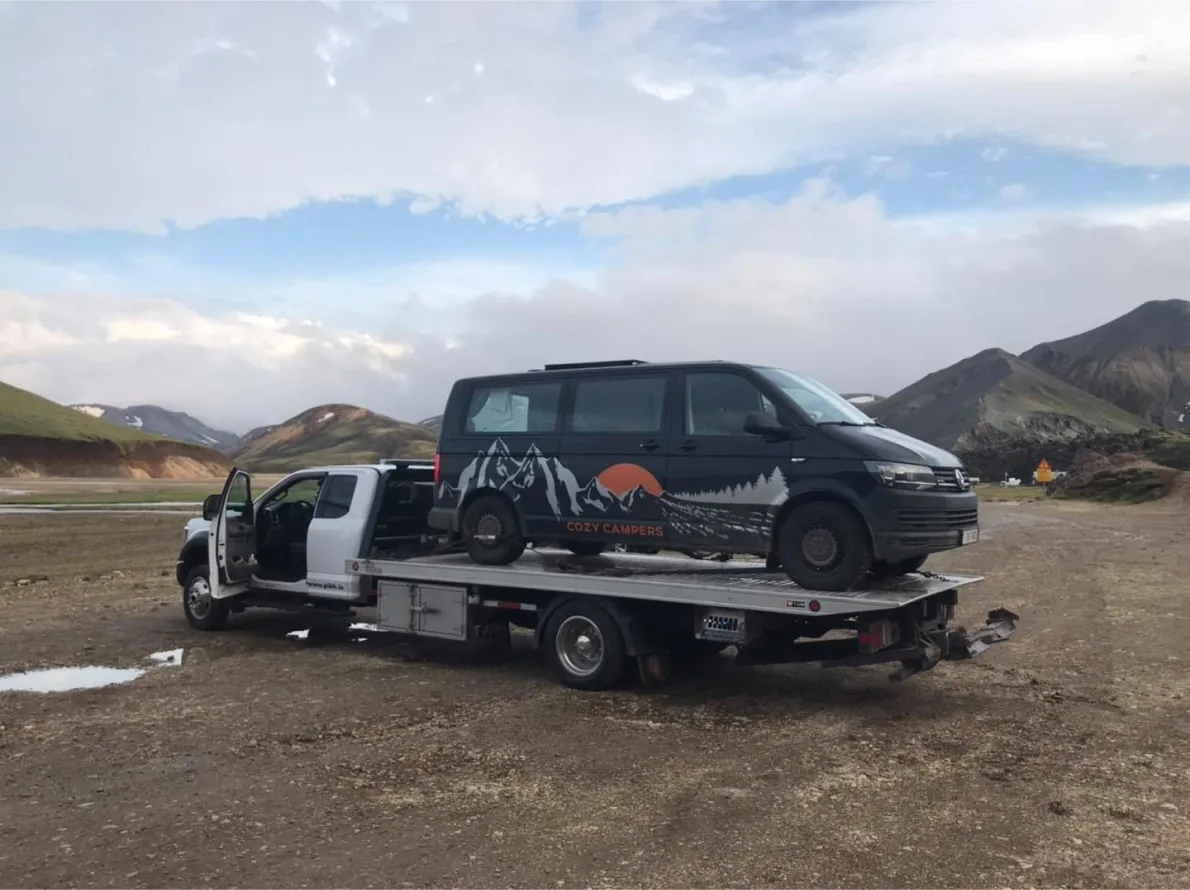
We offer customer support for on-road assistance every day from 9:00 to 18:00. You can reach out to us for guidance and assistance regarding any issues you encounter with your camper, included items or extras.
After hours calls are automatically redirected to 24 Road Assistance and only urgent matters are addressed.
The cost of on-the-spot assistance is the renter’s responsibility, unless the incident is caused by a vehicle malfunction.
Please note that malfunctions with the camper, included items or extras must be reported as soon as they occur!
For added peace of mind while traveling, you can purchase our Roadside Assistance extra. It covers the cost of the most common incidents where on-the-spot assistance is needed.
For Urgent On-Road Assistance Call +(354) 771 5131
Tolls and fees
Renters are responsible for following local regulations concerning tunnel tolls, parking fees and speeding fines. Staying informed can not only help you avoid extra charges but also ensure a smooth and enjoyable experience.
Parking Fees
Most tourist attractions charge for parking, even if you drop by for only 10-15 minutes. It’s best to settle these fees at each location otherwise you’ll get a fine and we charge a service fee for each fine we need to process.
Most locations require you to pay either online or via an app, typically through Parka, although other service providers are used in some places. Therefore, it’s essential to pay attention to the specific payment method required at each site.
Note: If you park the camper illegally in a city or a town the fine can be quite expensive so make sure you are parking where it is allowed.
Road tolls
Some roads, tunnels, and bridges in Iceland may charge a toll, which must be paid online or through the relevant app. Unpaid tolls may result in additional charges, and Cozy Campers applies a service fee for each unpaid toll we need to process.
For added peace of mind, consider purchasing our road Toll Pass for unlimited use of all covered toll roads, tunnels, and bridges. Simply drive through without having to arrange each payment yourself.
Speeding Fines
Cameras are located in cities / towns, along the ring road and inside tunnels. If you drive over the speed limit, you may receive a fine. Be aware that Speeding fines are quite expensive in Iceland. These fines are handled by the Icelandic authorities.
Road Signs and Regulations


Icy Road
Danger of sudden icy conditions

Animals
Watch out for the possibility of animals on the roads!

Blind Crest
Please keep to the far right side of the road! Another car could be coming the other way

Single Lane Bridge
Slow down and look ahead. The car that reaches the bridge first goes first; if the other car is closer, stop and let it cross.

Speeding camera
Make sure you are not driving more than the maximum speed

Very rough track
Only for specially equipped off-road vehicles.

Single lane tunnel
Slow down and watch for oncoming headlights. Use the passing bays (marked M) to let oncoming cars by, and follow the signs at the entrance.

Closed road
The road ahead is closed due to road condition or other reasons

Gravel roads
Slow down! Gravel road ahead.

Difficult road
Not passable for ordinary cars; only for high 4x4 vehicles.

Pavement changes to gravel
Slow down! Gravel road ahead

Unbridged river
Unbridged river ahead: 4x4 vehicles only. Crossing a river is always at your own risk; no insurance covers water damage.

Roundabout
Roundabout ahead. In two-lane roundabouts, the car in the inner lane has priority when leaving.
Maximum Speed





Are You Ready For the Icelandic Roads?
8 quick questions about driving a camper in Iceland. After each answer you see why it is right.
-
Show answer
90 km/h
The limits are 50 km/h in towns, 80 km/h on gravel and 90 km/h on paved roads outside towns. Iceland has no faster motorways, and 120 km/h on a 90 road costs 80,000 ISK.
-
Show answer
80 km/h at most, and slower when the surface is loose or the road is narrow
The limit is 80 km/h, but it is a maximum, not a target. A heavy camper on loose gravel needs much longer to brake and can slide on bends.
-
Show answer
Slow down before the gravel starts, then steer gently
Where the asphalt ends, the edge is often loose and uneven, and braking or steering hard on the gravel is how cars roll over. Slow down while you are still on the asphalt.
-
Show answer
The car that reaches the bridge first
Icelandic law gives priority to the vehicle that reaches a single-lane bridge first. Slow down early so you can stop and let the other car cross; the Ring Road alone still has 26 of these bridges.
-
Show answer
Keep to the far right and slow down: a car may come over the top in the middle of the road
Many rural roads are narrow and unmarked at the crest, and drivers coming the other way often drift to the middle. Never overtake near a blind crest.
-
Show answer
Pull into the next lay-by or wide spot when it is safe and let them pass
Campers are slower and hard to see past, so impatient drivers overtake in risky places. Letting them pass at a safe spot is safer for everyone. Only overtake yourself where you can see far ahead, never on bridges, crests or bends.
-
Show answer
In a marked parking area or lay-by, fully off the road
Stopping on the road, on bridges, in tunnels, at crests or on bends is against the law and causes serious accidents. Drive on to a safe place where your whole camper is off the road.
-
Show answer
Slow right down and be ready to stop: the lamb may run across to its mother
Sheep roam free in summer and lambs often dash to their mother. If you hit an animal you must tell the farmer or the police, and damage from hitting an animal is not covered by insurance.
-
Show answer
Park facing into the wind and hold the door with both hands
A gust can rip a door open and bend the hinges in a second, a common and expensive damage in Iceland. Park so the wind blows the door shut, and hold on to it.
-
Show answer
vedur.is for weather warnings and umferdin.is (road.is) for road conditions
vedur.is publishes the official yellow, orange and red warnings, and umferdin.is shows closed roads and live wind gusts. The weather can change within hours, so check both every morning.
-
Show answer
You may not drive it: red means closed or impassable and grey means unknown condition
None of our campers may drive roads marked red or grey. It costs €10 per km, measured by the tracker, and no insurance covers damage there. If a road turns red while you are on it, leave it as soon as you can.
-
Show answer
Yes: pay with the app or website shown on the sign, usually Parka or Check-it
Cameras read your number plate. Unpaid parking is billed to us with an extra charge, and we add a €20 handling fee for each fine we process.
-
Show answer
Online within 24 hours, unless you have our Toll Pass
There are no booths: cameras record your number plate. Pay at spolur.is (Hornafjörður) or tunnel.is (Vaðlaheiðargöng) within 24 hours, or get our Toll Pass and simply drive through.
-
Show answer
Always, day and night, all year
It is the law in Iceland. The “Auto” light setting can leave the rear lights off in daylight, so switch your headlights on yourself.
-
Show answer
No: everyone must sit in a seat with a seatbelt on
Everyone in the camper must wear a seatbelt while driving; the fine is 20,000 ISK per person.
-
Show answer
0.2‰, so even one drink can be too much
The limit is 0.2‰. From 0.5‰ you also lose your licence for at least two months and pay a 90,000 ISK fine. Don’t drink and drive.
-
Show answer
No: driving off roads and numbered tracks is illegal in Iceland
Off-road driving is banned by law and can lead to heavy fines or even prison. Tyre tracks in moss and sand can take decades to heal. With us it also costs €10 per km, and nothing is insured.
-
Show answer
At a campsite, or on private land with the landowner’s permission
Outside towns, Icelandic law only allows campers to stay overnight at campsites, or with the landowner’s permission. Most car parks at tourist sites forbid overnight stays too.
-
Show answer
At the pump with a card and PIN, or with a prepaid fuel card bought in the station shop
Most stations are self-service and open around the clock, but the pump asks for your card PIN. Buy a prepaid card during opening hours as a backup, and fill up early in remote areas.
-
Show answer
112
112 is the number for police, ambulance, fire and search and rescue in Iceland. The 112 Iceland app can also send your exact location. Call us afterwards about the camper.
Frequently Asked Questions
What happens if the road changes to Red or Gray while I’m driving it?
If you drive into a road marked with Red or Gray on the road condition map on umferdin.is (road.is) you will get a fine for each driven km.
However, if the road changes into Red or Gray while you are driving on it you will not get fined, with the condition you exit the road as soon as possible.
Please note that the tracking device allows us to see when you entered the road and how far you drove and we have access to road updates, so we can see when a road turns Red or Gray.
What is the difference between F-road and Off road?
F-roads are mountain roads only accessible with 4×4 vehicles, these roads have a name and a number.
Note: F-roads are CLOSED during winter. They usually open in late June or early July, depending on snow; check umferdin.is.
Off road is considered to be any place that does not have a road name or a number, such as but not limited to: tracks, paths, beaches, grass, moss or any other place with fragile vegetation where damage can be caused to nature which can take decades to heal. Under Icelandic law, off-road driving can lead to heavy fines or even prison.
What should I do if there is a storm?
Monitoring weather alerts on vedur.is is crucial for staying safe during a storm. The alerts are color coded depending on the severity of the storm:
Yellow: Be cautious while driving. We ask you not to drive our campers when the wind is over 20 m/s: campers catch a lot of wind, so stay put while the storm is passing. You can see live wind speed and gusts along the road on umferdin.is.
Orange: Avoid area if possible or cancel your travel plans and find a safe place for you and your camper to stay while the storm is passing.
Red: Avoid area or cancel your travel plans and seek shelter while the storm is passing. Sometimes, when the storm is severe enough humanitarian assistance centers are opened in areas hit with such storms and we encourage you to use those if available.
Stay informed and prioritize safety during severe weather conditions:
Safe Travel
Weather Alerts
Road Conditions
Where can I sleep in the camper?
Outside towns, you may only stay overnight in a camper at a campsite, or on private land with the landowner’s permission. Parking areas, lay-bys and viewpoints are not campsites, and many car parks forbid overnight stays.
See our campsites page for where to stay.
How do I pay for fuel?
Most fuel stations are self-service, open 24/7, and you pay at the pump with a card and PIN. If your card has no PIN, buy a prepaid fuel card in the station shop during opening hours.
In the East and the Highlands stations are far apart, so fill up when you can. Check whether your camper takes diesel or petrol before filling.
What do I do if I hit a sheep?
Stop when it is safe and report it to the farmer or the police (112). Damage from hitting an animal is not covered by insurance.